Abstract
Ceramic filters have singular properties such as high permeability and specific surface area associated to low density. Some examples of their use can be found in liquid metal deep filtration, water treatment, air purification, and others. These particular properties are dependent on the filters’ manufacturing process. One of the most used techniques to produce filters is the replication method, which provides a dimensional network of struts and interconnected pores. However, a common issue of all ceramic filters produced by this technique is their low mechanical strength due to the hollow struts and micro cracking generated during the thermal decomposition of the sponge. Intending to address this limitation and produce filters with higher mechanical strength, this paper analyzed a modified process route for manufacturing filters. Samples of preheated Al2O3 filters were vacuum infiltrated with ceramic suspensions (Al2O3 and SiO2) of different solids concentrations (15‐40 wt%), particle size distribution (nano to micro metric size) at distinct processing times (1‐5 minutes). The data analysis indicated that the best balance among mechanical strength, mass, and strut thickness was achieved by infiltration with SiO2 colloidal suspension (40 wt%) per 1 minute. SEM analysis confirmed that the struts were filled and microcracks were sealed with colloidal particles.
KEYWORDS
ceramic filters, ceramic foam, filters fabrication, vacuum infiltration
1 | INTRODUCTION
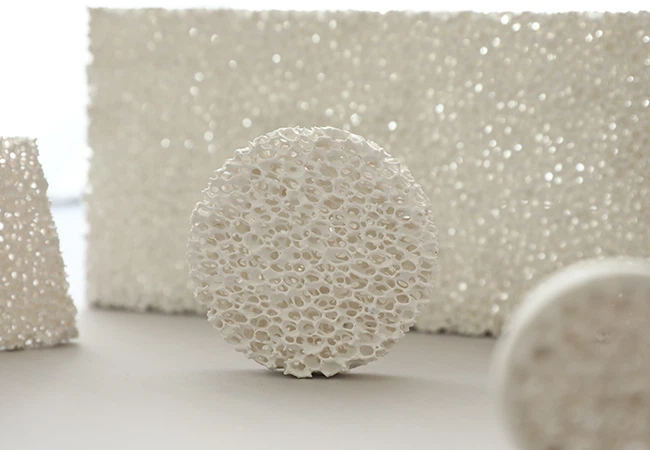
Reticulated ceramic foams are open‐pores materials (porosity level in the range of 70%‐95%), formed by a threedimensional network of interconnected struts.1,2 This weblike structure induces tortuous flow paths that favor fluid mixing and improve contact between solid particles and the inner filter surface, enhancing trapping efficiency. Due to this interesting feature, the application range of these porous materials has spread to several solid‐fluid contact processes,for instance molten metal filters, gas and diesel engine emissions filters, catalyst support, combustion burners, volumetric absorbers in solar thermal receivers and reactors, biomaterial, and others.1,3–6
Patented in 1963 by Schwartzwalder and Somers,7 the polymeric sponge replica method is widely used for production of reticulated ceramic foams. This method involves coating a polymeric sponge by dipping it into a shear‐thinning ceramic suspension. The impregnated sponge is then compressed by rollers to ensure void cells are filled with suspension and to remove the excess of slurry. After that, the coated sponge is dried, and then is slowly fired to pyrolyze the polymeric sponge and sinter the ceramic material. Therefore, regardless of ceramic composition and sponge cell size, usually foam filters produced by the replica method present low strength due to the hollow struts and cracks generated during the thermal decomposition of polymeric foam, as shown for Zr2SiO4 and SiC filters (Figure 1). Brown and Green8 identified that the thermal expansion differences between the polymeric sponge and the ceramic coating is the main reason for filter struts to crack.

Many investigations focused on minimizing this shortcoming have been proposed in the literature. Basically, they comprise four different strategies: (a) improving the wetting surface of the polymeric sponge5,9; (b) controlling the pyrolysis of the polymeric sponge10; (c) adding a secondary coating by dipping, spraying or vacuum infiltration with solid suspensions to cover/fill the flaws at the struts4,11–18; and (d) adding fibers19 and/or improving solid particle packing of suspension.20 Additional coating by dipping, spraying or vacuum infiltration of presintered ceramics is an effective route to increase the compressive strength of these materials by densification of struts.12–16 However, regardless of the chosen coating process, the use of ceramic slurries, even low viscosities, may cause the struts to thicken. In this case, the result is a subsequent and undesirable decrease in permeability.
Aiming to improve the Al2O3‐based filters’ mechanical properties (strength, friability, and thermal shock resistance) and keeping their high level of permeability by the vacuum infiltration process, this paper evaluated the influence of the processing parameters as solids concentration (15‐40 wt%) and particle size (nano to micrometric) of suspensions at different infiltration times (1‐5 minutes). Nowadays the advances in process engineering have enabled not only the constantly increasing production of new nano materials on an industrial scale, but also their production in a cost‐effective way. Thus, using nano materials to produce porous ceramics became an interesting technological alternative to be explored.21,22
2 | MATERIALS AND TECHNIQUES
2.1 | Materials and samples preparation
Al2O3‐based filters were produced by the replica method using 10 ppi (pores per inch) polyurethane sponge (Heisgiess, Germany) of 50 × 50 × 25 mm3 as the template material. The ceramic suspension was comprised by fine aluminas (CL370C and CT3000SG; Almatis, Ludwigshafen, Germany), colloidal silica (Bindzil 1440; Eka Chemicals, Bohus, Sweden) as the sintering additive,

Castament® FS20 (Basf, Germany) as the dispersant, Rhodopol ® 23 (Rhodia; São Paulo, Brazil)as the thickener, Polyvinyl alcohol (0.2 wt%) as the binding additive, Silicone as the anti‐foaming agent and distilled water (Table 1). All raw materials were firstly homogenized in a high shear mixer for 1 hour at room temperature before the slurry was impregnated on the polymeric foam. Figure 2 presents the conventional and proposed processes for producing foam ceramics step‐by‐step using the replica sponge method. By the conventional process, after impregnation and compression by rollers, the samples are coated with a thin layer of low viscosity suspension. After that, they are dried at 110°C for 15 minutes and then fired to pyrolyze the polymeric sponge and sinter the ceramic material. According to the proposed process, after impregnation and compression by rollers, samples are initially heated up to 600°C per 1 hour (heating rate = 1°C min−1) to burnout the sponge. Because of the high reactivity of colloidal silica in the composition, the ceramic skeleton presents good strength for further steps. Then, samples were placed in a vacuum infiltration chamber for filling in the generated hollow struts and flaws due to the sponge burnout.
This step was carried out considering different solids concentration of fine Al2O3 suspensions (15 and 30 wt%, <10 μm), distinct sol size of colloidal suspensions (SiO2 sol—40 wt%, 14 nm and Al2O3 sol—40 wt%, 80 nm), and the infiltration time ranging from 1 to 5 minutes.

2.2 | Techniques
Different properties were investigated to characterize the ceramic filters. First, the samples’ mass (m) and strut thickness (t) were measured after sintering at 1150°C for 1 hour. Strut thickness evaluation and further analyses of the microstructure (cracks generated due to sponge burnout and infiltration/coating by the ceramic slurries) were carried out using a stereo‐microscope (Zeiss, Jena, Germany) and SEM equipment (Inspect S50, FEI, Hillsboro, OR). The strut thickness investigation took place after the vacuum impregnation step. Five samples of each filter type were analyzed. The images were taken in the filter’s central region, avoiding border effects. At least 11 strut thicknesses were measured per sample, as shown in Figure 3.
Therefore, not less than 55 struts were evaluated per filter composition. Mechanical tests on the sintered filters were performed by evaluating the compression strength (ASTM C133‐94) using a MTS 810 device with a 5 kN cell and cross‐head speed of 2 mm min−1. For this purpose, 50 × 50 × 25 mm3 samples were positioned between rubber plates of 5 mm thickness to ensure an uniform loading on the foam surface. The pressure drop (ΔP/L) across sintered filter samples was measured using the designed apparatus shown in Figure 4.1 Permeability constants k1 and k2 were obtained by fitting Forchheimer’s equation (Equation 1) to the experimental data of ΔP/L vs water flow velocity (vs).1,23

where, L is the sample’s average thickness, μ and ρ are the fluid viscosity and fluid density, respectively, and k1 and k2 are constants only dependent on the medium properties,known as Darcian (k1) and non‐Darcian (k2) permeabilities, respectively. Five samples of each vacuum impregnation set were considered for permeability evaluation. The pressure drop (ΔP) was collected as a function of the fluid velocity (vs). This procedure is schematically illustrated in Figure 4. For each sample, three tests were carried out. The fluid’s density and viscosity were calculated as function of the temperature. Friability of the sintered ceramic foams was attained in a vibratable flow‐table apparatus (ASTM C1445‐13), commonly used to determine the flow behavior of castable compositions. The mass of the sintered specimens (50 × 50 × 25 mm3) was measured before and after tumbling them on the flow‐table for 5 minutes at 66 rpm and ≈1.3 mm vibration amplitude. Prior to each weighing, the samples were carefully cleaned with pressurized air to remove surface dust. Concerning the thermal shock tests, sintered filters (1150°C for 1 hour) were subjected to a total of five heating and cooling cycles (ASTM C1171‐91). The samples were place into a furnace chamber previously heated at 1125°C and kept at this temperature for 15 minutes. After that, they were withdrawn and cooled in air for another 15 minutes, leading to thermal gradients of roughly 1100°C. This procedure was considered as one full cycle. The damage caused by the thermal changes was evaluated by compressive strength measurements at room temperature.


3 | RESULTS AND DISCUSSION
This section has been organized into two parts. The first one presents the effect of the particle size and solid concentration of ceramic suspensions on the properties of vacuum infiltrated Al2O3‐based filters. The second part shows the influence of colloidal suspensions features on the vacuum infiltrated filters. The results were compared to the reference filters produced by the proposed process without the vacuum impregnation step. Specifically for the permeability analysis, results from commercial filters reported in the literature1 were also considered.
3.1 | Effect of particle size and solids concentration of suspensions on infiltrated filters
It is well known that in order to attain a good ceramic coating on the polyurethane foam substrate, the ceramic suspension must have suitable rheological features (shearthinning behavior).24 Moreover, the solid content and raw materials particles’ size will also play an important role in the final properties of the generated foam.5,13 Figure 5 points out some of the main features observed in the dried alumina filters after sponge burnout and the vacuum infiltration with alumina or colloidal silica suspensions.

Regarding the samples that were impregnated with Al2O3 suspensions (Figure 5A,B), the triangular hollow channels still remained within the struts and, besides that, the solid particles were preferentially placed on the external surface of the reticulated structures. Conversely, more effective filling up of the triangular voids and sealing the cracks were observed after vacuum infiltrating with the colloidal
silica suspension (Figure 5C,D). These results indicated that the reduced size (14 nm) and lower density (1.264 g cm−3) of the colloidal SiO2 suspension favored better covering of the flaws/defects before the sintering step. Nevertheless, the coating process by vacuum infiltration may lead to the struts thickening with a significant reduction in the permeability of reticulated porous ceramic. Hence, measurements of the total mass and the strut thickness were carried out for the vacuum infiltrated filter samples with alumina and colloidal silica suspensions for 1, 2, or 5 minutes, followed by sintering at 1150°C for 1 hour. Figure 6 shows that compared to the reference samples, the Al2O3 infiltrated samples (15 and 30 wt% of solids) presented higher mass and thicker struts (Figure 6A,B).
Regarding those infiltrated with colloidal SiO2, similar results or just a minor increase in the strut’s thicknesses and samples’ mass were attained when compared with the reference samples. Figure 7A points out the larger open‐pores and thinner struts in the final microstructure of the colloidal SiO2 infiltrated samples, whereas Figure 7B highlights the generation of a thicker coating layer on the struts infiltrated with the Al2O3 suspension (15 wt% of solids) for 5 minutes. As expected, the reinforcement of the struts resulted in higher compressive strength for the filter samples submitted to vacuum infiltration with alumina or colloidal silica suspensions (Figure 8). Nevertheless, despite the improved mechanical behavior, a drawback associated to infiltration with the Al2O3 suspensions was the high pressure drop (ΔP/L) detected during the permeability measurements (Figure 9). This effect is related to the buildup of solid particles at the original struts and, consequently, the formation of thicker walls that reduced and/or blocked the pore channels. Permeability is an important aspect for reticulated porous ceramic application. For instance, molten metal filtration using reduced permeability filters might lead to liquid melt freezing, increasing its viscosity, the mold fulfilling time and, consequently, affecting the metallurgical production conditions. It is important to highlight that the permeability behavior of porous media depends on its pore structure and fluid properties such as the viscosity and density at testing temperature. 1,25,26 Therefore, the composition of the porous structure does not influence the permeability results. Based


on that, the permeability behavior of ceramic filters with comparable pore sizes but distinct compositions, as the Al2O3 and Al2O3–SiC filters,1 can be analyzed together. One of the most significant results from Figure 9 is that the SiO2 sol preferentially fills the hollow struts and minimally affect the permeability of filters. It can be observed


that filters infiltrated with colloidal SiO2 present pressure
drop (ΔP/L) values in the same range as the commercial ones (Al2O3–SiC based) produced by the conventional replica sponge method1 and similar behavior when compared to the reference one. Considering the better filling of voids, crack sealing (Figure 5C,D), lower mass, thinner struts, and high permeability shown by filters infiltrated with colloidal SiO2, using commercial colloidal suspensions is a viable and suitable route to enhance the properties of reticulated porous ceramics.
3.2 | Influence of colloidal suspension features on the infiltrated filters
Nowadays there are various commercial colloidal suspensions available on the market, presenting different concentrations, particle sizes, pH, and cost. In order to analyze the influence of colloidal alumina and silica suspensions on the filter properties, additional tests were carried out on the filter samples submitted to vacuum infiltration for 1, 2, and 5 minutes. Both suspensions presented 40 wt% of solids and pH 10, but different sol size: Al2O3 = 80 nm and SiO2 = 14 nm.
As highlighted in the micrographs of Figure 10, alumina and silica nano‐particles were able to fill in the hollow struts derived from the sponge burnout. Figure 10D shows a crack sealed with SiO2 particles after the infiltration of the sample for 1 minute. This effect was observed for both colloidal suspensions, which might be associated to their lower sol sizes (SiO2: 14 nm, Al2O3: 80 nm). Figure 11 shows the results attained for the mechanical, fluid‐dynamic, and physical properties of infiltrated filters with colloidal suspensions after firing at 1150°C for 1 hour. The infiltration of alumina and silica particles on the flaws contained in the structure led to a slight increase of the samples’ mass (Figure 11A) and the strut thickness (Figure 11B). However, these changes were not as significant as the ones observed for the samples infiltrated with conventional alumina suspensions (Figure 6B). Compressive strength data (Figure 11C) indicated that the infiltration of the selected nano‐particles resulted in filters with higher mechanical resistance due to the reinforcement of struts when compared with the reference composition. Furthermore, the colloidal SiO2 infiltrated ones showed similar permeability level as the reference samples (Figure 11D), which is a consequence of thinner struts compared with samples infiltrated with colloidal Al2O3.
In order to evaluate the changes in mechanical strength, mass, and strut thicknesses caused by vacuum infiltration of filters with colloidal suspension for 1, 2, and 5 minutes, an Optimization Parameter (OP) was calculated,1 as follows:

where, OP is the optimization parameter, σi, mi, and ti correspondto compression strength, mass, and strut thickness, respectively, for sample i submitted to vacuum infiltration for 1, 2, or 5 minutes. σmax is the highest mechanical strength achieved, mmin is the lowest mass attained, and tmin is the lowest strut thickness of the set of evaluated samples. The OP value ranges between 0 and 1. The highest OP value indicates that the best possible combination of the evaluated properties was achieved.

Figure 12 depicts the Optimization Parameter (OP) values associated to the reference filter samples and the vacuum infiltrated ones with colloidal suspensions. Despite the data scattering, the highest OP was attained for filters infiltrated with colloidal SiO2 for 1 minute. Thus, the optimum combination of filters properties was obtained for the follow conditions of the vacuum infiltration process: colloidal SiO2 suspension, 40 wt% of solids, 1 minute of infiltration time. The difference between the Al2O3 and SiO2 colloidal infiltrated samples’ properties might be related to the suspension density and the colloid size (Table 2). As schematically illustrated in Figure 13, the lower size of the nano‐SiO2 resulted in better filling and packing of particles at the hollow voids and cracks at struts. Consequently, the SiO2 infiltrated samples presented higher mechanical strength and lower mass when compared to the ones infiltrated by colloidal Al2O3. This trend can be clearly identified in Figure 14, which shows that SiO2 infiltrated samples for 1 minute presented the highest mechanical strength/mass ratio, attesting the best processing condition obtained in this study. Friability is also an important aspect of ceramic filters and it is measured by mass loss due to surface abrasion and impact damage.27 Vibrations during transportation can cause severe damages and restrict the use of filters in some processes, for instance the release of broken pieces (bits) can contaminate the molten metal during its filtration step. Figure 15 indicates that in comparison to reference filter, the infiltrated samples with colloidal suspensions showed lower mass loss in all evaluated conditions (after 1, 2, or 5 minutes of vacuum infiltration). The decreased friability of colloidal infiltrated filters is most probably related to densification of cell walls, as clearly shown in Figure 10B,C. The compressive strength of the sintered filters samples before and after five thermal shock cycles are shown in Figure 16. It can be noted that, regardless of colloidal suspension (SiO2 or Al2O3), the mechanical strength before and after cyclic thermal shock were higher than that for the reference filters. The slight drop of strength after thermal shock is due to the thermos mechanical stresses and consequent damage of the material. For the reference filters after five thermal shock cycles a reduction of 6% on the compressive strength was attained. One important trend is that both 5‐minutes infiltrated filters (alumina and silica) presented the highest relative damaging (14% and 11%, respectively), whereas in absolute values both resulted in stronger materials (27% and 51%, respectively) when compared to the reference filters. The damage for filters infiltrated for 1‐minute are close (3% for alumina and 5% for silica), being the latter the highest in absolute

strength when compared to the reference (67%). Nevertheless, taking into account not only the relative damage, but also the absolute final strength, the filters 1‐minute silica infiltrated resulted the best outcome, corroborating with the results presented in Figures 12 and 14. The better overall thermal‐shock result presented by silica infiltration over alumina can be justified by the lower thermal expansion coefficient and Young’s modulus presented by the first. It can be concluded that not only the filling of the hollow struts, but the thermo‐mechanical behavior of the filling material have a substantial influence over the final filter strength.
4 | CONCLUSIONS
According to the results presented in this paper, a suitable alternative to enhance the mechanical strength, thermal shock resistance and friability of alumina‐based ceramic filters consists of processing the reticulated structure with colloidal suspensions via vacuum infiltration technique. In this study, various parameters were analyzed such as vacuum infiltration time, using conventional (μm) or colloidal suspensions (nm) and the solid content of suspensions. Based on the proposed Optimization Parameter that combines strength, samples’ mass and struts’ thickness, the best processing condition to be used for the production of improved ceramic filters was attained when the materials were vacuum infiltrated with colloidal silica of 40 wt% of solids per 1 minute. Moreover, the nano‐particles’ promoted denser and thinner cell struts, where the former contributes to reducing the friability, and the latter provides high permeability level of the ceramic filters. In addition, the better thermal shock performance showed by this processing condition is due to the low thermal expansion coefficient and Young′s modulus of silica.


REFERENCES
1. Salvini VR. Processing and evaluation of fluid dynamic and thermomechanical properties of ceramic filters in the Al2O3-SiC system. Federal University of São Carlos; 2001.
2. Colombo P. Conventional and novel processing methods for cellular ceramics. Philos Trans A Math Phys Eng Sci. 1838;2006 (364):109–24.
3. Studart AR, Gozenbach UT, Tervoort E, Gauckler LJ. Processing routes to microporous ceramics: a review. J Am Ceram Soc. 2006;89(6):1771–89.
4. Zhu X, Jiang D, Tam S, Zhang Z. Improvement in the strut thickness of reticulated porous ceramics. J Am Ceram Soc. 2001;84 (7):1654–6.
5. Luyten J, Thijs I, Vandermeulen W, Mullens S, Wallaeys B, Mortelmans R. Strong ceramic foams from polyurethane templates. Adv Appl Ceram. 2005;104(1):4–8.
6. Ali S, Mutharasan R, Apelian D. Physical refining of steel melts by filtration. Metall Mater Trans B. 1985;16(4):725–42.
7. Schwartzwalder K, Somers AV, inventors; Gen Motors Corp, assignee. Method of making porous ceramic articles; 1963.
8. Brown DD, Green DJ. Investigation of strut crack formation in open cell alumina ceramics. J Am Ceram Soc. 1994;77(6):1467–72.
9. Jun IK, Koh YH, Song JH, Lee SH, Kim HE. Improved compressive strength of reticulated porous zirconia using carbon coated polymeric sponge as novel template. Mater Lett. 2006;60 (20):2507–10.
10. Han YS, Li JB, Wei QM, Tang K. The effect of sintering temperatures on alumina foam strength. Ceram Int. 2002;28(7):755–9.
11. Pu X, Liu X, Qiu F, Huang L. Novel method to optimize the structure of reticulated porous ceramics. J Am Ceram Soc. 2004;87(7):1392–4.
12. Jun IK, Kong YM, Lee SH, Kim HE, Kim HW, Goretta KC. Reinforcement of a reticulated porous ceramic by a novel infiltration technique. J Am Ceram Soc. 2006;89(7):2317–9.
13. Vogt U, Gorbar M, Dimopoulos-Eggenschwiler P, Broenstrup A, Wagner G, Colombo P. Improving the properties of ceramic foams by a vacuum infiltration process. J Eur Ceram Soc. 2010;30(15):3005–11.
14. Liang X, Li Y, Liu J, Sang S, Chen Y, Li B, et al. Improvement of the mechanical properties of SiC reticulated porous ceramics with optimized three‐layered struts for porous media combustion.Ceram Int. 2017;43(4):3741–7.
15. Liang X, Li Y, Sang S, Xu Y, Chen Y, Li B, et al. Enhanced mechanical properties of SiC reticulated porous ceramics via adjustment of residual stress within the strut. Int J Appl Ceram Technol. 2018;15(1):28–35.
16. Liang X, Li Y, Wang Q, Sang S, Xu Y, Chen Y, et al. A nitride whisker template for growth of mullite in SiC reticulated porous ceramics. Ceram Int. 2017;13(14):11197–203.
17. Zhu X, Jiang D, Tan S. Preparation of silicon carbide reticulated porous ceramics. Mater Sci Eng A. 2002;323(1):232–8.
18. Chen F, Yang Y, Shen Q, Zhang L. Macro/micro structure dependence of mechanical strength of low temperature sintered silicon carbide ceramic foams. Ceram Int. 2012;38(6):5223–9.
19. Paiva A, Sepulveda P, Pandolfelli VC. Processing and thermomechanical evaluation of fibre‐reinforced alumina filters. J Mater Sci. 1999;34(11):2641–9.
20. Emmel M, Aneziris CG. Development of novel carbon bonded filter compositions for steel melt filtration. Ceram Int. 2012;38(6):5165–73.
21. Storti E, Dudczig S, Schmidt A, Schmidt G, Aneziris CG. Filter functionalization with carbon nanotubes and alumina nanosheets for advanced steel filtration. Steel Res Int. 2017;88(10):1700142.
22. Storti E, Dudczig S, Hubálková J, Gleinig J, Weidner A, Biermann H, et al. Impact of nanoengineered surfaces of carbonbonded alumina filters on steel cleanliness. Adv Eng Mater. 2017;19(9):1700153.
23. Dullien FA. Porous Media: Fluid Transport and Pore Structure. San Diego: Academic press; 1992.
24. Voigt C, Aneziris CG, Hubálková J. Rheological characterization of slurries for the preparation of alumina foams via replica technique. J Am Ceram Soc. 2015;98(5):1460–3.
25. Innocentini MDM, Salvini VR, Pandolfelli VC, Coury JR. Assessment of Forchheimer’s equation to predict the permeability of ceramic foams. J Am Ceram Soc. 1999;82(7):1945–8.
26. Innocentini MDM, Sepulveda P, Salvini VR, Pandolfelli VC. Permeability and structure of cellular ceramics: a comparison between two preparation techniques. J Am Ceram Soc. 1998;81 (12):3349–52.
27. Shen H, Nutt S. Mechanical characterization of short fiber reinforced phenolic foam. Compos Part A Appl Sci Manufac. 2003;34(9):899–906.